June Beef Export Value Above Year-Ago
In June, the value of U.S. beef exports increased from a year ago despite lower volumes, according to data released by USDA and compiled by the U.S. Meat Export Federation (USMEF). June pork exports were below last year, largely due to a sharp decline in pork variety meat exports attributable to pseudorabies-related restrictions that have since been lifted by Mexico and Colombia.
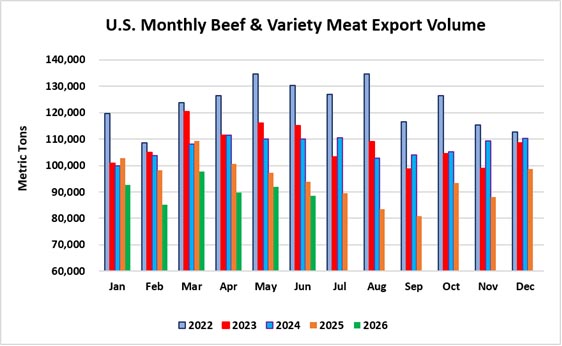
June beef exports totaled 88,586 metric tons (mt), down 6% from a year ago. However, export value was up 3% to $790.1 million, bolstered by year-over-year increases in Japan, Taiwan, the ASEAN region, Central America, South Korea, Hong Kong, the Caribbean and Africa. Export value was nearly steady to the Middle East but declined to Mexico, Canada and China. For the first half of 2026, beef export volume was 9% lower than a year ago at 545,649 mt, while value fell 4% to $4.74 billion.
Much of this decline was due to the continued absence from China, where beef exports were strong in the first quarter of 2025 before China allowed U.S. facility registrations to expire. Although these registrations were renewed during President Trump’s visit to China in May, exports to China remain minimal due to plant suspensions and uncertainty over China’s residue testing – trade barriers that U.S. officials are working to resolve. When China is removed from the January-June results, beef export volume declined just 1% from the first half of last year while xport value increased 6%.
“While we never want to see exports down year-over-year, global demand for U.S. beef continues to be very resilient,” said USMEF President and CEO Dan Halstrom. “USMEF greatly appreciates the Trump administration’s persistent efforts to resolve the outstanding issues facing U.S. beef exports to China. The economic situation throughout Asia remains challenging, with lost purchasing power in U.S. dollar terms, yet customers continue to purchase a wide range of U.S. beef cuts, at record prices. This gives us an optimistic outlook for the second half.”
Source: USMEF

